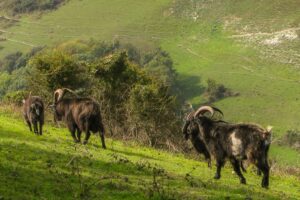
If you look up from the Ventnor Esplanade toward the towering green cliffs of the Downs, you aren’t just looking at a beautiful backdrop – you’re looking at a wild habitat. For decades, a herd of feral goats has called these steep, chalky slopes home. Encountering them as the mist rolls off the English Channel is a “Jurassic Park” moment that you simply won’t find anywhere else in the South of England.
Where to Find Them
The goats are masters of the “Vertical Town” and can be found anywhere on the high ridge overlooking the town. For the best chance of a sighting, take the path from the town centre up toward St Albans Steps, then follow the trails onto the open downland.
The Best Time to Spot Them
- Golden Hour: The herd often moves to the higher ridges at sunset to catch the last of the warmth. The views across Sandown Bay from here are world-class.
- Early Morning: They can often be found grazing on the lower “shelves” of the cliff before the town wakes up.
Conservation and Respect
These goats aren’t just for show; they play a vital role in the UNESCO Biosphere of the Isle of Wight. By grazing on the scrub, they help maintain the rare chalk grassland that allows wildflowers and butterflies to thrive. Remember, they are wild animals – keep your distance, keep dogs on leads, and bring a good zoom lens.
Observe Goat Behaviour
The goats are tough, self-sufficient and well-adapted to life on the steep, windswept slopes of the Downs.
Billy goats will attempt to assert their dominance over other males with a fixed stare and a lowering of the horns. This may lead to a ‘clash’, where horns are locked until a victor finally emerges.
The goats are not aggressive towards humans, though, and are generally seen as having an endearing intelligent look.
Nanny goats form a separate group from the males, with a lead matriarch and their young kids in tow.
The Ventnor Goats’ Diet
Goats can graze like sheep but prefer to browse woody vegetation, including tree bark. They enjoy a varied diet on the Downs, consisting of holm oak, ash and sycamore, as well as coarse grasses, bramble and hawthorn.
Once a tree’s bark has been stripped, the tree will slowly die, starved of water and nutrients, this is the major benefit of goats helping to regenerate the environment.
Goats and the Holm Oak
The spread of the holm oak posed a serious threat to the chalk grassland on the Downs, causing butterfly and insect populations to dwindle. Since the goats were introduced onto the Downs by the National Trust in 1997, the holm oak has gradually been brought under control and an increasing amount of Ventnor’s important chalk grassland habitat restored.
Flower-rich turf has been re-established and butterflies – such as the striking Adonis blue – that rely on these chalk-loving plants, have made a comeback.
A Perfect Base
Guests at Gills Cliff House are perfectly positioned for this adventure, as you can join the trail on St Albans Steps almost as soon as you step out of the front door.

Leave a Reply
You must be logged in to post a comment.