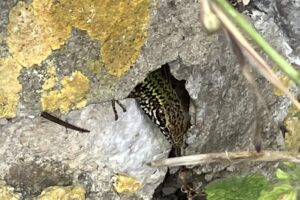
If you spend a sunny afternoon strolling along the terraces, seafront, or stone walls of Ventnor, you are likely to hear them before you see them: a sudden, sharp rustle in the dry leaf litter, followed by the flash of a bright green or mottled brown tail disappearing into a rocky crevice.
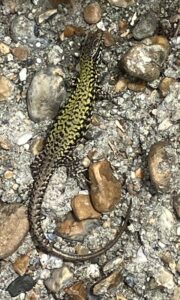
Welcome to the world of the Common Wall Lizard (Podarcis muralis). While the Isle of Wight is famous for its red squirrels and soaring coastal birds, Ventnor boasts a completely unique natural phenomenon: the oldest and largest established colony of wall lizards in the entire United Kingdom.
A Dash of Mediterranean Mystery
How did a reptile native to mainland Europe and the sun-drenched hills of Italy end up thriving on a British island? Local history is full of colorful theories. One popular legendary tale claims an Italian ship carrying cargo wrecked off the Ventnor coast in the 19th century, allowing the stowaway lizards to scramble ashore. More reliable historical records point to a deliberate release by a local resident, Dr. Martin, back in 1841, or a naturalisation from escaped captive pets in the early 20th century.
Whatever their true origin story, modern science has stepped in to uncover the facts. University of Oxford researchers analysed the DNA of Ventnor’s scaled residents and confirmed that their genetic lineage traces directly back to northern Italy.
Why Do They Love Ventnor?
But Ventnor is different. Nestled beneath the towering chalk downs, the town sits inside the Undercliff microclimate, which shields the area from cold northerly winds and traps the warmth of the sun. Averaging significantly warmer temperatures than the UK mainland, this “Mediterranean of the North” provides the exact sun-baked, rocky topography these agile climbers need to thrive.
Where to Spot Them
Unlike most shy British reptiles, wall lizards are bold urban wildlife and are rarely intimidated by humans. They can grow up to 20 cm long and love to sun themselves on south-facing stone structures. Top spots for a “lizard safari” include:
-
The Terraces: These distinctive retaining walls are an absolute stronghold for the colony. Look closely and you will frequently see custom tubes installed right into the stonework—a proactive conservation measure to ensure they have safe tunnels away from predators.
-
La Falaise Car Park: The sunny, rocky banks and sea walls overlooking the beach are classic basking territories.
-
Ventnor Botanic Garden: Walk the paths of the Arid and Mediterranean Gardens on a bright day between April and October to watch them hunting along the stone ledges.
Great Accommodation
Stay in our holiday lets and you will not fail to see lizards as soon as the sun is out.

Leave a Reply
You must be logged in to post a comment.